
This article shows you: Singapore Walking Tour: Telok Ayer to Lau Pa Sat

This short walking tour invites you to continue your adventure after the Singapore River Walk, leading you into the historic Telok Ayer district with its charming old streets and echoes of the city’s earliest days.
Although the walk is short, it is very picturesque. Along the way, you will visit ancient Chinese temples and the former headquarters of one of Singapore’s most important clan associations.
I’ll also guide you to a hidden spot where you can savor coffee in an authentic setting, making this walk a memorable finish to your journey.
Telok Ayer to Lau Pa Sat Map
This 1.8 km Telok Ayer walk takes about 45–60 minutes and is one of the easiest self-guided walks in Singapore.
Click “Details” to download the GPX file and open it in apps like Outdooractive or Maps.me to navigate the walk. Best used with apps like Outdooractive or Maps.me.
Distance: 1.8 km
Time: 45–60 minutes
Difficulty: Easy
Start: Yueh Hai Ching Temple
Finish: Lau Pa Sat Hawker Centre
Nearest MRT: Raffles Place / Telok Ayer
1. Yueh Hai Ching Temple

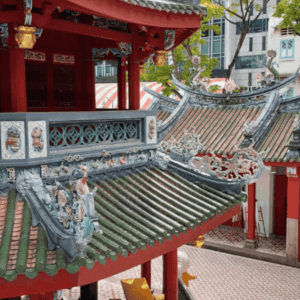
Our walk begins at Yueh Hai Ching Temple, one of the oldest temples in Singapore, located in the historic Telok Ayer district.
It was founded in the 1820s by Chinese seafarers and merchants who came here to give thanks for their safe journeys.
The temple is dedicated to Mazu, the Goddess of the Sea, and is famous for its colourful roof decorations and intricate wood carvings.
I really enjoyed my visit and even had the chance to light incense, a traditional offering in Chinese temples.
2. Telok Ayer Street

Next, we walk along Telok Ayer Street, a charming street in the historic Telok Ayer district of Singapore. It is lined with restaurants, cafés, and bars.
This historic street in Singapore is especially pleasant in the evening, when the buildings and terraces are softly illuminated. It is a great place to sit outside and enjoy the atmosphere.
Many visitors on a Singapore walking tour stop here for a drink before continuing the walk.
If you enjoy discovering Singapore on foot, you might also like exploring Fort Canning Park, a peaceful green hill in the heart of the city.
3. Fuk Tak Chi Temple

A few steps further, we reach Fuk Tak Chi, one of Singapore’s oldest Chinese temples, founded in the 1820s by Hakka and Cantonese immigrants.
The temple was dedicated to the Earth Deity, known as Tua Pek Kong, protector of the local community.
I really loved stepping inside this place. It felt like a traditional Chinese courtyard house, with wooden beams, tiled floors, and an open central courtyard.
In the centre, you can see a detailed miniature model showing how the area looked in the past.
If you’d like to explore the area further, you can continue with my Chinatown Singapore Self-Guided Walking Tour, with more temples, heritage shophouses, and hidden streets.
4. Ying Fo Fui Kun

A few steps further along Telok Ayer Street, we arrive at Ying Fo Fui Kun, one of the earliest clan houses established in Singapore in 1822–23.
It was founded by Hakka immigrants who had just arrived on the island.
I learned that this place helped new immigrants settle in Singapore and provided support for the community.
It was interesting to discover how important clan associations were for early Chinese immigrants.
Singapore’s cultural diversity is fascinating. If you enjoy neighborhoods full of color, temples, and street life, you might also like my Little India Singapore Walking Map & Itinerary.
5. Nagore Dargah
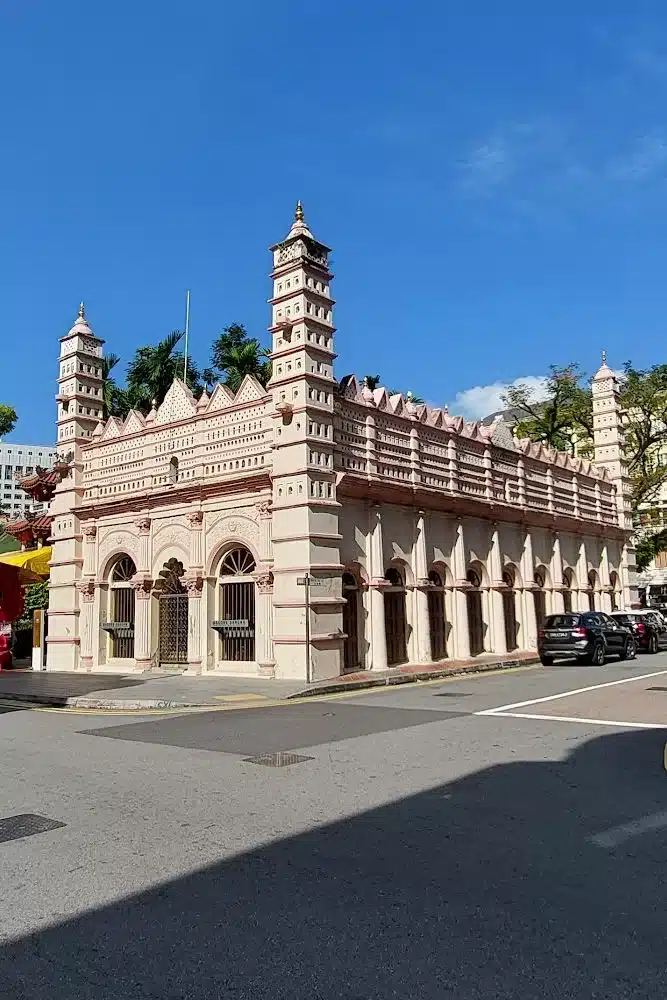
Just around the corner stands Nagore Dargah, a small shrine built between 1827 and 1830 by the Indian Muslim community in Singapore.
It was dedicated to the Muslim saint Shahul Hamid of Nagore in southern India and reflects the multicultural history of Telok Ayer.
I describe this fascinating place in more detail in my Chinatown walking tour.
6. Thian Hock Keng Temple
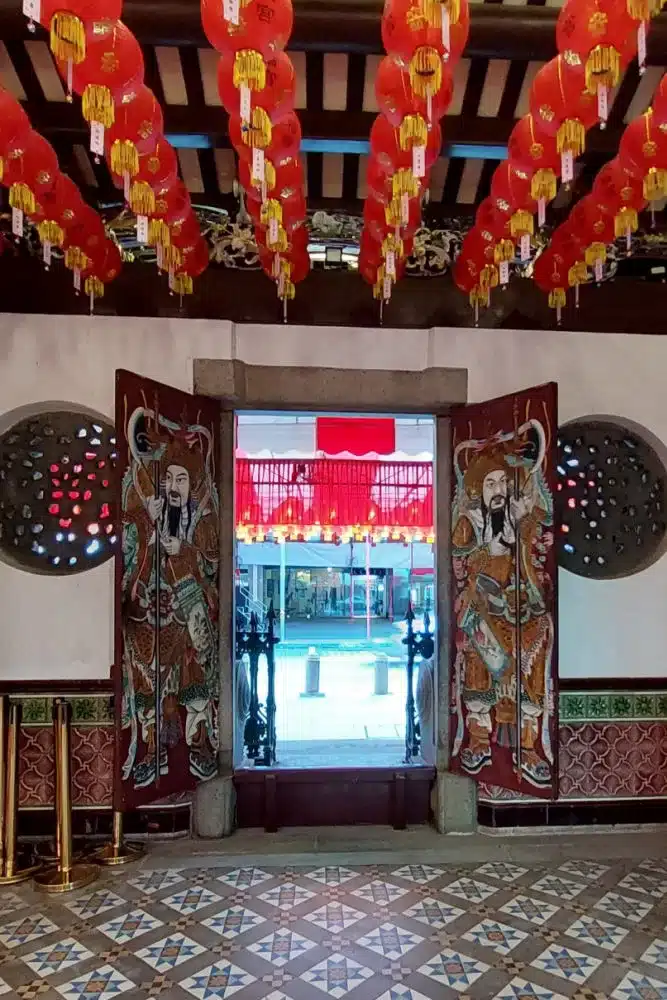
A short walk brings us to Thian Hock Keng Temple, one of the oldest and most important Chinese temples in Singapore.
It was built by Hokkien immigrants who arrived by sea in the 19th century.
These sailors believed that the goddess Mazu protected them during the dangerous journey from China, and they built this temple to thank her after arriving safely.
Even today, it remains one of the most beautiful and historic temples in Singapore.
7. Le Shan Cafe – Singapore Walking Tour

Le Shan Cafe. It’s a lovely place to stop for a traditional kopi — the strong local coffee usually served with condensed milk.
I really enjoy sitting here for a moment before continuing the walk.
The building’s traditional Chinese architecture and quiet atmosphere make it feel like a small step back into old Singapore.
A perfect little break before heading to the final stop of the walk.
8. Lau Pa Sat – Final Stop of This Singapore Walking Tour

A few minutes later, the walk ends at Lau Pa Sat, one of Singapore’s most iconic food markets.
It’s a beautiful Victorian iron structure that rises in the middle of the modern skyscrapers of the financial district.
As evening approaches, the smell of grilling satay begins to fill the air, and Boon Tat Street turns into the famous Satay Street. It’s the kind of place where locals and travellers sit together over simple, delicious food.
A wonderful way to end the walk — with good food and the lively atmosphere of Singapore.
Another beautiful route is the Singapore River Walk from Robertson Quay to Marina Bay, perfect for sunset views and skyline photography.