

I’ve prepared this free walking tour of Nijmegen city to discover on foot the places I find most beautiful and interesting in the city.
Rich in history, Nijmegen combines its charming upper town with the lively riverside along the Waal.
This Nijmegen walking tour is perfect for a weekend trip, with easy train connections from Amsterdam and Utrecht.
Location: Were do we start?
This walking itinerary starts at Mariënburg Kapel right in the heart of historic Nijmegen and ends at the beautiful Valkhof park.
Interactive Map: Historic Nijmegen Walking Tour
Use this interactive Google Map to follow the walking route through the historic streets of Nijmegen. Tap the red pins to explore each location.
I created a Google Maps route so you can explore this walk at your own pace.
🏨 Short on time? Our top hotel picks in Nijmegen include:
- ⭐⭐⭐⭐ Mercure Hotel Nijmegen Centre – Central 4-star stay, just 0.7 km from downtown. Very Good 8.2 (2,226 reviews).
- ⭐⭐⭐⭐ Hotel Oranjestaete – Boutique charm, top location only 250 m from the center. Wonderful 9.1 (1,045 reviews).
- ⭐⭐⭐ Guesthouse Vertoef – Stylish design guesthouse near the train station. Very Good 8.0 (2,295 reviews).
- ⭐⭐⭐⭐ Bastion Hotel Nijmegen – Comfortable stay with parking, just outside the center. Very Good 8.0 (1,588 reviews).
✨ All hotels are easily connected to the Free Walking Tour Nijmegen route.
1. Mariënburg Kapel – Start of The Walk

This 15th-century chapel has a unique two-level design: the lower floor was for regular people, and the upper gallery for the convent’s sisters.
It’s interesting how they could attend the same service without seeing each other.
Over the centuries, the chapel has served many purposes—from a hospital to a theater.
Today, it houses the Huis van de Nijmeegse Geschiedenis, where you can explore the city’s rich history through exhibitions and events.
📍 Address: Mariënburg 26, Nijmegen
2. Mariekenstraat

We continue this free walking tour in Nijmegen along the Mariekenstraat.
It is one of my favorite spots in Nijmegen. It’s full of shops and feels modern, but also cozy.
The design is unique: one side curves inward, the other outward. Two architecture firms created it; some say the contrast represents a feminine and masculine side.
I don’t know if that was the real intention, but you can feel two different moods as you walk through.
📍 Address: Mariekenstraat, Nijmegen
3. De Schommel (The Swing)

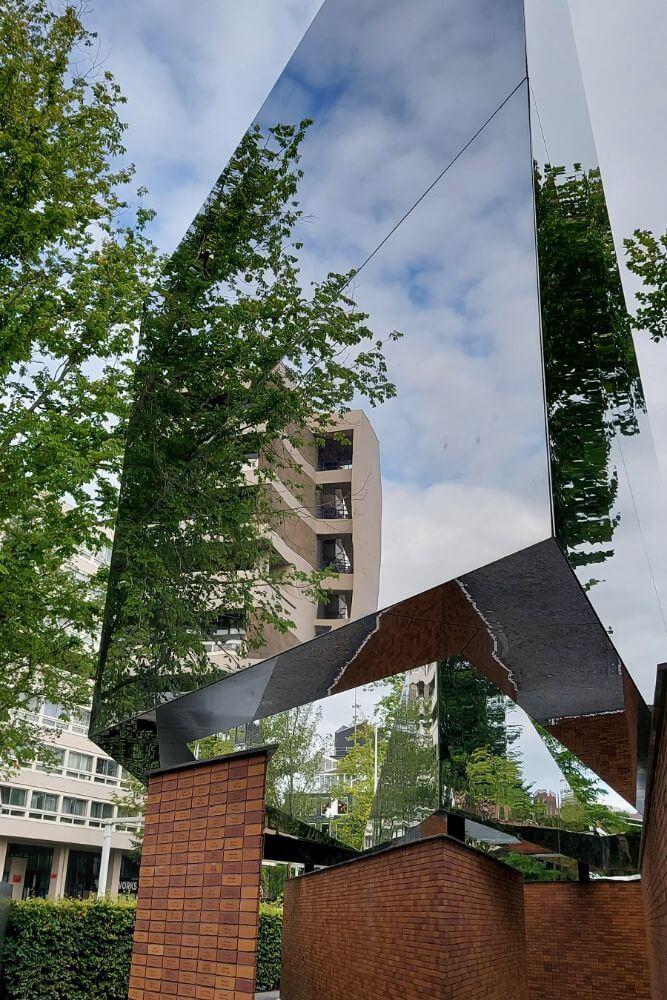
The Swing (De Schommel) is a moving monument that serves as a reminder of the tragic bombing on February 22, 1944.
During which 763 people lost their lives, including 24 children and eight nuns from a nursery school located on this site.
This location is a testament to the tragic bombing.
Many stories have emerged about children who skipped school that day by a stroke of luck and did not attend school during the subsequent period, without knowing that this event would spare their lives.
American planes bombed Nijmegen by mistake. They were aiming for Germany but hit the city instead.
📍 Address: Raadhuishof, Nijmegen
4. De Blauwe Steen (The Blue Stone)

The Blue Stone in Nijmegen was first mentioned in 1522 at the crossroads of the city’s four medieval quarters.
It became the central place of justice: sentences were read aloud, criminals were chained to an iron ring, and punishments were carried out in public.
People witnessed whippings, the cutting of fingers or ears, and even the burning of forbidden books.
This simple stone turned into a stage of fear and power in the very heart of the city.
Over the centuries the stone was replaced several times.
The current version, laid in 1976 by carnival association De Blauwe Schuit, is now a symbol of Nijmegen’s history and traditions, often called “the heart of Nijmegen.
📍 Address: In front of the Stadhuis
5. The Historic Town Hall – Stadhuis van Nijmegen

The very first town hall stood near the Lage Markt in the lower town, but the current complex on the Burchtstraat has existed since the late 14th century.
You’ll see it as part of this free walking tour Nijmegen, since it’s one of the most iconic landmarks in the city.
📍 Address: Burchtstraat 20A
6. The Facade of The Town Hall

After World War II, the bombing in 1944 severely damaged the façade, and sculptors rebuilt many elements to restore Nijmegen’s historic appearance.
- Seven Medallions:
At the top, under the roofline, you see seven medallions symbolizing the virtues: Prudence, Justice, Temperance, Fortitude, Charity, Hope, and Faith—recreated by Martinus van Dijk after the 16th-century originals. - 18 Sculpted Heads:
Above the windows, arranged in two rows, are 18 sculpted heads, also carved by Martinus van Dijk in 1948. - Eight Statues of Rulers and Heroes:
At street level stand eight statues of rulers and heroes from Nijmegen’s past: Emperor Frederick Barbarossa, Emperor Trajan, Emperor Charles IV, Charlemagne, Emperor Charles V, King William II, Claudius Civilis, and Julius Caesar—Remade by Albert Termote in the early 1950s. - Madonna and Child:
At the corner of the Town Hall, also Remade by Albert Termote in the early 1950s, after the originals by Cornelis Sass (1553) were lost in the war.
7. Gedeputeerdenplaats – Deputies’ Courtyard

Through the gate to the right of the stairs you enter the Gedeputeerdenplaats, usually open to the public.
On the walls you see stones and plaques that recall the war in the Dutch East Indies, the liberation on 5 May 1945, and the Battle of Nijmegen in 1944.
Across the courtyard stands the old gate of the Quarterly Academy, Nijmegen’s first university (1655–1680), while scattered fragments of city walls and gates give a glimpse of the past.
8. De Waagh – Historic Weighing House

De Waag (The Weigh House) was built in 1612, replacing an older medieval building that once served as a meat hall.
Here, all market goods had to be officially weighed, ensuring fair trade and preventing sellers from overcharging buyers.
Since 1977, De Waagh has not just been a café and restaurant, but a vibrant meeting place.
📍 Address: Grote Markt 26, Nijmegen
9. De Latijnse School – The Latin School

The Latin School is a historic school building in Nijmegen. It was built in 1544 by architect Herman van Herengrave, who also designed parts of the town hall.
This building once served as a Latin school, where students, primarily boys, were prepared for university, with a focus on classical education, grammar, and philosophy.
Statues of emperors and rulers decorate its façade, honoring key figures from Nijmegen’s past.
📍 Address: Sint Stevenskerkhof 2, Nijmegen
10. Stevenskerk – Stevenschurch

The St. Stevens Church was built around 1254 and consecrated in 1272 by Albertus Magnus, a bishop from Cologne. A relic of him is still in the church’s Heilig Graf Chapel.
Builders have often expanded and rebuilt the church, though parts of the original Romanesque-Gothic structure remain.
The church and its tower have shaped Nijmegen’s skyline ever since.
The tower was severely damaged in World War II but rebuilt in 1953—it’s the same one you can still climb today. (Steens Skywalk).
📍 Address: Sint Stevenskerkhof 2, Nijmegen
11. The Très Riches Heures Panels – Art by the Van Limburg Brothers

Outside the Stevenskerk, colorful panels reproduce scenes from the Très Riches Heures du Duc de Berry, one of the most famous medieval manuscripts.
Each image illustrates a different month, showing farm work, seasonal tasks, or noble pastimes, and together they create a vivid window into daily life in the 15th century.
France keeps the original, but the Van Limburg brothers, born in Nijmegen, gave the city a proud artistic connection.
📍 Address: In front of Stevenskerk
12. Achter de Hoofdwacht

As we descend the weathered cobblestone steps, the charm of the historic streets surrounds us.
We pass by Achter de Hoofdwacht 7, a charming shop with a large collection of LPs and vinyl records in its window, Waaghaal records.
Nijmegen’s oldest café, “In de Blaauwe Hand”, is also on this street. (Achter de Hoofdwacht 3).
📍 Address: Achter de Hoofdwacht 3, Nijmegen
13. Kitty de Wijze

Kitty de Wijze, a 22-year-old Jewish woman from Nijmegen, boarded a train to Auschwitz with her sister Joke in December 1942.
During the journey, they wrote postcards to their parents to comfort them and hide their fear. They threw the cards out of the moving train, hoping someone would find them and send them home.
In her messages, Kitty said they were treated well, felt healthy, and believed everything would be fine, even though she likely knew the truth.
The train carried Kitty and Joke to their deaths, but the postcards reached Nijmegen a few days later, offering a final glimpse into their courage and love.
📍 Address: Kitty de Wijzeplaats, Nijmegen
14. The Elephant on Priemstraat

As you turn the corner onto Priemstraat, look up and see a small elephant sculpture on the wall.
This marks the former “De Olifant” grocery store, which operated here from 1795 to 1908.
It sold colonial goods like coffee and tea, and the elephant symbol helped identify the shop at a time when many people couldn’t read.
Today, the sculpture remains a charming detail—a quiet reminder of Nijmegen’s everyday history.
📍 Address: Piemstraat 57, Nijmegen
15. St. Anthonispoort – Maarten Schenck Gate

The St. Anthonispoort is one of the few medieval city gates of Nijmegen still standing. Once a sign of power, it marked the entrance to the city and even served for executions and Catholic processions.
On 10 August 1589, Maarten Schenk van Nydeggen tried to capture Nijmegen through this gate, but the citizens and the Spanish garrison fought him back.
His boat capsized on the Waal, and he drowned in his heavy armor—his body later displayed as a grim warning.
📍 Address: Lage Markt 47D, Nijmegen
16. The Waal River at the Waalkade
Here we pause at the Waalkade, with an impressive view of the wide Waal River, the busiest branch of the Rhine.
From this spot, you can watch cargo ships and river traffic glide by, and it’s also a great place to cycle along the river on the smooth bike path.
📍 Address: View from the Waalkade Google location: RVX7+X6C, Nijmegen
17. Spoorbrug Nijmegen – Railway Bridge

If you look at the left side of the river you will se The Spoorbrug; Nijmegen’s railway bridge across the Waal, a steel landmark that connects the city with the rest of the Netherlands.
From here, trains run directly to Amsterdam in less than two hours and to Utrecht in just over an hour, making Nijmegen both historic and well connected.
18. Waalbrug – The Iconic Bridge

If you look at the right side you will see The Waalbrug, opened in 1936, which is a Nijmegen’s landmark arch bridge across the river Waal.
In 1944, it played a decisive role in Operation Market Garden, when Allied troops fought to secure the crossing and liberate the city.
Today, the bridge still shapes Nijmegen’s skyline and stands as a symbol of both connection and resilience.
19. Foxy Coffee & Concept Store

Take a break at Foxy, a cozy spot that combines great coffee with a modern design.
From the terrace, you can sit back and watch the river life go by, enjoying one of the loveliest views in Nijmegen — and it’s also a great stop along this free walking tour in Nijmegen.
📍 Address: Waalkade 15, Nijmegen
20. Floodgates at Lage Markt

At the Lage Markt, modern floodgates stand ready to protect Nijmegen from the high waters of the Waal.
Most of the time they remain open, but in February 2021 they closed during rising floods—a quiet reminder of the city’s life with the river.
We continue our free walking tour in Nijmegen along the river.
📍 Address: Google location: RVX7+VG6, Nijmegen
21. Waterwolf & Aquanaut Sculpture

On the Waalkade, the bronze sculpture Waterwolf & Aquanaut (2020) by Spacecowboys recalls Nijmegen’s deep history by the river.
The howling wolf looks back to the city’s Roman origins, when Noviomagus became the first Roman city in the territory that is now the Netherlands around 98 CE.
The name Nijmegen still comes from it today.
Beside the wolf, the young aquanaut in a diving suit celebrates the city’s lasting bond with the Waal, where ancient Rome and modern Nijmegen meet.
📍 Address: Waalkade 51, Nijmegen
22. The Besiendershuis

Built in 1525 in late Gothic style, the Besiendershuis is the oldest surviving house in Nijmegen. Its name comes from the assumption that it was once home to a besiender—the official who collected tolls from ships sailing on the Waal.
One of its early residents, Wouter Kolf, suffered a tragic fate here: three of his wives died in the house, the last while pregnant, giving the building a dark reputation.
Over time, stories of ghostly presences and unexplained events only deepened the mystery.
Today, the Besiendershuis hosts artists-in-residence, connecting new creative projects with Nijmegen’s history.
📍 Address: Steenstraat 26-28, Nijmegen
23. Roman Wall – Self-Guided Walking Itinerary

During the construction of Holland Casino in the 1980s, archaeologists uncovered the largest Late Roman monument in the Netherlands: a wall of volcanic rock built around the late 3rd or early 4th century.
This wall, 80 meters long and 4 meters high, once protected a Roman riverside town with lively trading along the Waal River.
Today, a fragment of the wall and remains of a Roman heating system can still be seen behind the casino.
📍 Address: Google location RVX8+GW, Nijmegen
24. Sint-Nicolaaskapel – St. Nicholas Chapel

This small chapel was built almost 1,000 years ago, around 1030, by Emperor Henry III. That makes it one of the oldest stone buildings in the Netherlands.
It used to stand inside a big castle called Valkhof Castle.
When the castle was torn down in 1797, people kept the chapel because they thought it might even be from Roman times.
Inside, you can still see the thick stone walls, old arches, and a heavy chandelier, which make it feel like you’ve stepped back into the Middle Ages.
📍 Address: Voerweg 1, Nijmegen
25. Valkhof Park – Nijmegen Self-Guided Walking Tour

We finish our free walking tour in Nijmegen at the Valkhof Park, where history and daily life come together.
Among the ruins of Barbarossa’s palace and the St. Nicholas Chapel, locals enjoy the green spaces with beautiful views over the Waal River.
Today, the park is not only a reminder of Nijmegen’s rich past but also a lively spot for concerts, festivals, and everyday relaxation.
A perfect place to end our tour — and to begin exploring the city center just a short walk away.
📍 Address: Google location: RVWC+Q5G, Nijmegen
End of the Free Walking Tour in Nijmegen
This is where our free walking tour Nijmegen comes to an end. The last stop is at the Valkhof Park Gate, one of the historic entrances to the city. From here, it’s just a short walk back into the center of Nijmegen, where you can explore more cafés, restaurants, and shops at your own pace.
Whether you want to relax by the riverside, enjoy a drink on the Grote Markt, or continue discovering hidden corners, the tour leaves you in the perfect spot to keep exploring.
FAQ – Free Walking Tour in Nijmegen
Yes, of course! You just need to follow the route, which tells you the history and interesting facts at each stop. All the stops are free to visit — you only pay if you want to enjoy a drink at a café or go up to the Stevenskerk Skywalk.
Yes! This walking tour that I share here is self-guided, super easy to follow, and comes with a Google Maps route and directions for every stop. You can explore Nijmegen’s old town, the Waalkade riverside, and landmarks like Valkhof Park and Stevenskerk at your own pace.
Nijmegen is the oldest city in the Netherlands, with Roman ruins, medieval streets, and the famous International Four Days Marches (Vierdaagse) held every July.
The Vierdaagse happens every year in mid-July. It’s the world’s biggest walking event, attracting over 40,000 walkers and a huge city festival. It’s great if you enjoy concerts and festivities, but if you want a quiet, relaxed walk, it’s better to avoid those dates because the city is very crowded (druk!).
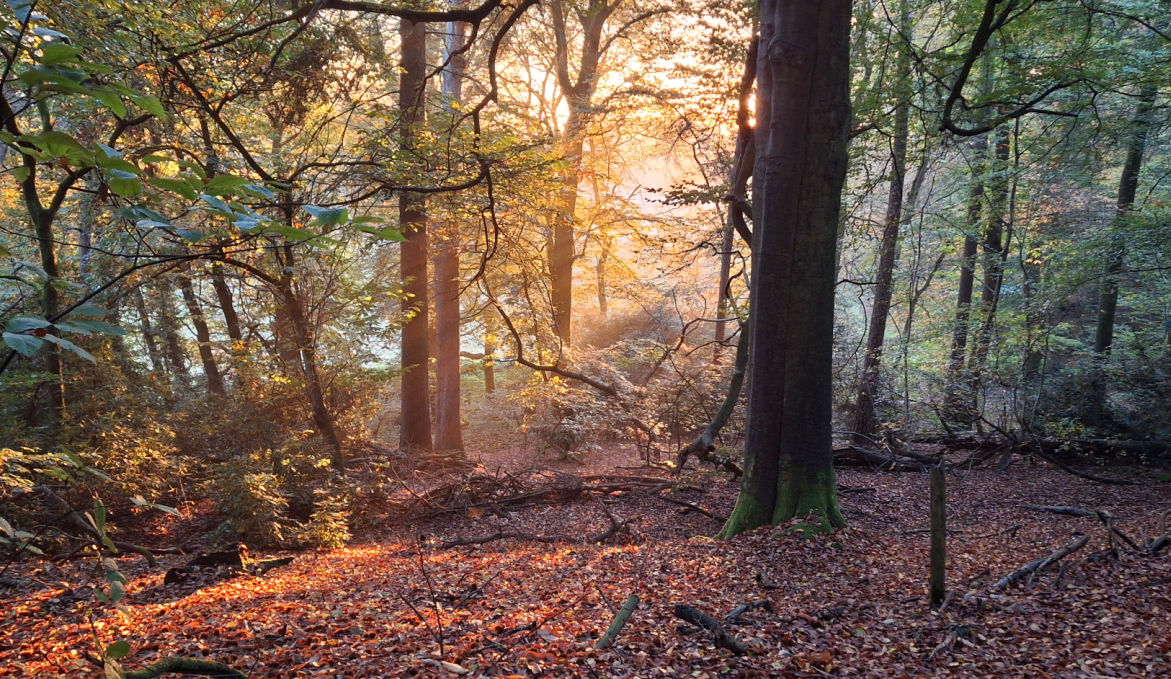
Yes! One of the best is the N70 Trail, a scenic hike through forests and hills around Nijmegen. It’s actually one of my favorite hikes — check out my detailed route for tips, maps, and highlights.
The train from Amsterdam to Nijmegen takes about 1h45, with frequent direct connections.
From Utrecht to Nijmegen, it takes about 1 hour by direct train, with services running throughout the day.
Highlights include Stevenskerk, Valkhof Park, the Roman wall remains, the Waalkade promenade, and the iconic Waalbrug (Nijmegen bridge).
Yes, you can take a boat tour on the Waal River to see Nijmegen from the water and enjoy its skyline and bridges.
Parking in Nijmegen is possible The best options are Keizer Karel Garage, Mariënburg Garage, and Kelfkensbos Garage, all within walking distance of the tour start. Day rates are around €3.90/hour and evenings are much cheaper.
This is a list with our Best Dutch Walking Routes
-
 Hiking the N70 Trail – Self-Guided Route in Nijmegen with Map
 -
 Amsterdam Self-Guided Walking Tour – Explore the Canals
 -
 Amstel River Walk – Best Amsterdam Hiking Route + Map
 -
 Amsterdam 3-Day Itinerary: Best Ideas to Plan Your Trip
 -
 Jewish Quarter Amsterdam Walking Tour: History & Sights
 -
 35 Essential Tips for Visiting Amsterdam – Travel Like a Local